
Check out our latest products


![[PETHROOM] Cat Nail Clipper Trimmer for Indoor Cats with Circular Cut Hole (2mm) | Premium Sturdy Stainless Steel Blade Cat Claw | Safe, Easy, Accurate, Quiet & Fast | Avoid Overcutting](https://m.media-amazon.com/images/I/6156hi88deL._AC_SL1298_.jpg)
![[PETHROOM] Professional Eye Comb for Pets | Stainless Steel Tear Stain Remover for Cats & Dogs | Gentle Round-Head Grooming Tool | Compact & Portable for Eye Gunk Removal](https://m.media-amazon.com/images/I/71+W758uwXL._SL1500_.jpg)
Find out how Lion’s Mane mushroom supports cognitive function, nerve repair, and overall brain health in dogs and cats. Explore its proven benefits and uses in holistic veterinary care.
As our dogs and cats age, maintaining sharp minds and healthy nerves becomes increasingly important. One powerful natural remedy gaining attention is Lion’s Mane mushroom for brain health in dogs and cats.
This remarkable medicinal mushroom, long valued in Eastern cultures, contains compounds that support nerve regeneration, cognitive function, and overall neurological well-being. From boosting memory and focus to helping protect against age-related decline, Lion’s Mane offers an effective way to keep your dog or cat’s brain healthy and resilient throughout life.
The rise of medicinal mushrooms
Most edible mushrooms contain a variety of nutrients, including B vitamins, amino acids, minerals, and immune-stimulating beta-glucans. Numerous research studies from China, Japan, Korea, Russia, and the Middle East have also shown that medicinal mushrooms can help with a range of health problems. These include liver and kidney disease, cancer, and heart disease.
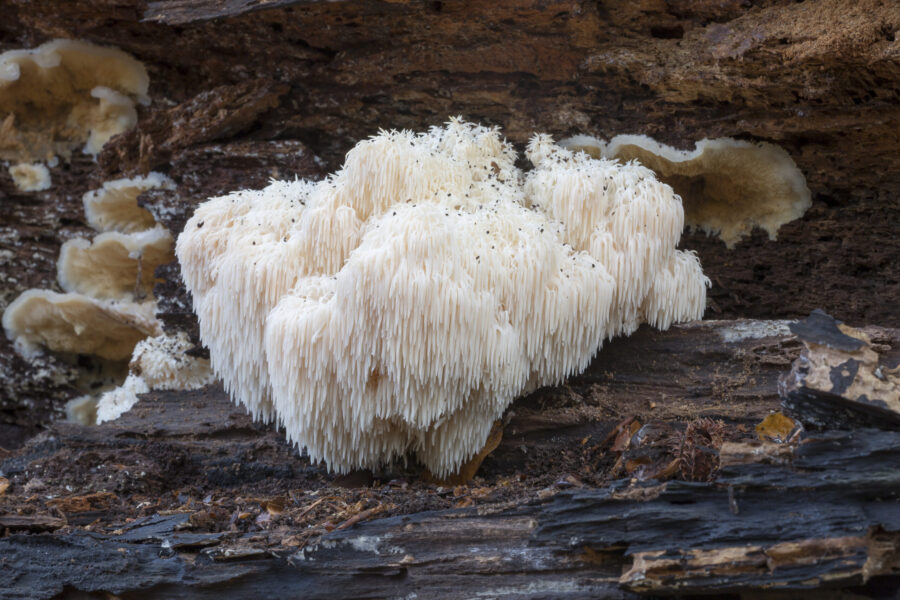
More recent research shows that the Lion’s Mane mushroom (Hericium erinaceous) improves brain health and regenerates nerves.
In the past ten years, holistic and integrative veterinarians in the US have increasingly explored medicinal mushrooms in veterinary medicine. Conventional veterinarians still consider the use of medicinal mushrooms “fringe,” though research into their benefits is ongoing
How Lion’s Mane helps with age-related diseases
In many developed countries, our lifespans (and those of our dogs and cats) have increased. As populations age, however, we’re seeing a rise in problems such as cognitive decline, dementia, Alzheimer’s and Parkinson’s disease. Unfortunately, researchers have not proven that any drug therapies cure these age-related diseases.
For centuries, people in China and East Asia have used Lion’s Mane as a medicinal food supplement, either dried and powdered, to be added to soups or made into a tea. Buddhist monks have long used Lion’s Mane tea to improve their concentration powers before meditation. This delicious mushroom can also be cooked and eaten fresh.
Japan, Korea and China have done research into Lion’s Mane for its abilities to help improve memory and brain function in humans. This mushroom can also enhance cognition and alleviate anxiety. In addition, studies have proven Lion’s Mane’s benefits for peripheral nerve regeneration.
What about our aging dogs and cats?
Like us, dogs and cats are living longer. They’re therefore more likely to develop age-related problems such as cognitive dysfunction.
Additionally, animals that consistently eat low-quality processed pet foods (especially kibble) are ingesting heavy metals (e.g. mercury, lead, cadmium and arsenic), pesticides and herbicides. These toxins are stored in the dog or cat’s body, including the brain tissue. They damage neurons, resulting in tremors and seizures as well as cognitive decline and brain tumors.
Lion’s Mane can repair a damaged nerve or brain
Researchers focus much of their work on the deterioration of the human brain during the “aging process” (oxidative stress), along with toxic chemical damage (chemotherapy, heavy metals, pesticides, etc.). They are especially interested in regenerating and repairing damaged brain cells and preventing diseases such as dementia.
Lion’s Mane is abundant in bioactive compounds. These include β-glucan polysaccharides, hericenones and erinacine terpenoids, isoindolinones, sterols, and myconutrients. These compounds potentially have neuroprotective and neurogenerative properties.
Studies show that the compounds in Lion’s Mane mushroom help regenerate myelin along the damaged axons (nerve re-myelination). This helps protect the brain from the effects of aging. Researchers also see huge potential in using Lion’s Mane to treat patients with multiple sclerosis.
These findings demonstrate that Lion’s Mane is a neuroprotective and anti-inflammatory agent for brain cells.
Lion’s Mane in veterinary medicine
Here is a list of medical problems in dogs and cats that would benefit from Lion’s Mane:
- Inflammatory bowel disease and colitis
- Gastric and esophageal carcinoma
- Separation anxiety
- Degenerative myelopathy in dogs
- Spinal cord trauma and disc disease
- Peripheral nerve damage (radial nerve)
- Nerve pain/sensory nerve analgesia
- Cognitive decline and dementia in senior animals
- Brain tumors
- Seizures due to toxin exposure
What dosage of Lion’s Mane should you use?
The potency of a commercial Lion’s Mane product can vary depending on how the mushroom is grown – i.e. wood chips, grain, special nutrients. How companies harvest, process, and store the mushroom also affects its potency (fruiting body, mycelium, or both).
Manufacturers usually produce medicinal mushroom products by extracting them in hot water and then dehydrating the powder. The dosage I use is as follows:
- Prevention: ¼ teaspoon per 10 pounds body weight, once daily
- Intervention (serious medical problem): ½ teaspoon per ten pounds body weight twice daily.
Some dogs and cats don’t like the mushroom flavor and smell. To cover it up, I recommend mixing a day’s worth of mushroom powder with warm bone broth, then adding the mixture to meals.
With any new supplement, including Lion’s Man, start with small amounts and work up to the prescribed dose after three to five days. Be sure to work with your veterinarian before starting your dog or cat on Lion’s Mane.
High doses of Lion’s Mane extract in capsules, taken on an empty stomach, may cause mild digestive discomfort in some individuals. Animals and people who are allergic to mushrooms should avoid using it.
From enhancing memory and cognition to supporting nerve regeneration and reducing inflammation, Lion’s Mane for brain health in dogs and cats offers remarkable benefits. These benefits are backed by both tradition and modern research. Lion’s Mane can be a valuable addition to your dog or cat’s wellness plan, especially for aging animals or those with neurological issues.
By working with your veterinarian to choose a high-quality product and proper dosage, you can help your dog or cat enjoy sharper mental function and a healthier, more balanced life.
NGF: a protein in Lion’s Mane
Lion’s Mane contains a protein called Nerve Growth Factor (NGF). This protein keeps the brain and nervous system regenerating and repairing. Dr. Hirokazu Kawagishi first discovered NGF; he has been researching medicinal mushrooms and brain health since 1991.
Lion’s Mane offers many other health benefits
Research demonstrates the use of Lion’s Mane for brain and nerve regeneration, but it has many more benefits. This mushroom is also:
- Anti-cancer
- Anti-diabetic
- Antibiotic
- Antioxidant
Additionally, Lion’s Mane helps:
- Modulate the immune system
- Metabolize fats and carbohydrates
- Lower Blood pressure
- Tonify the body’s vital energy
- Improve liver function
- Improves gastritis and IBD.
Post Views: 22