
Check out our latest products


![[PETHROOM] Cat Nail Clipper Trimmer for Indoor Cats with Circular Cut Hole (2mm) | Premium Sturdy Stainless Steel Blade Cat Claw | Safe, Easy, Accurate, Quiet & Fast | Avoid Overcutting](https://m.media-amazon.com/images/I/6156hi88deL._AC_SL1298_.jpg)
![[PETHROOM] Professional Eye Comb for Pets | Stainless Steel Tear Stain Remover for Cats & Dogs | Gentle Round-Head Grooming Tool | Compact & Portable for Eye Gunk Removal](https://m.media-amazon.com/images/I/71+W758uwXL._SL1500_.jpg)
When my Chihuahua, Kio, crash-landed into my life, he was already 12 years old. While technically a senior, his emotional age was somewhere between a caffeinated squirrel and an action-movie stunt double. I nicknamed him Forrest Gump because wherever he was going, he was running.
Now, Kio’s hearing has faded, and his vision has dimmed. Arthritis has quietly settled into his joints, stiffening movements that were once effortless. What hasn’t changed is his desire to be close to me. If I sit on the couch, he wants to be right beside me. When I go to bed, he still curls against my legs like he has every night since the day I brought him home.
But letting him jump on and off furniture no longer feels safe. As someone who has worked in clinical veterinary settings, fostered medical cases, and cared for dogs of all sizes and breeds, I know exactly how quickly a routine jump can turn into a life-changing emergency.
Senior dogs like Kio lose coordination and strength, their joints grow more fragile, and their spines are less forgiving. One misstep or awkward landing could mean a painful injury he may not easily recover from. As much as I cherish having him beside me, allowing Kio to jump up and down now feels less like freedom and more like a gamble with his comfort and safety.
So when I agreed to try the DoggoRamps Small Dog Bed Ramp and Couch Ramp, I was not just reviewing a product. I was protecting my little man’s spine, joints, and independence.
Why Dog Ramps Matter More Than Most People Realize
The Hidden Impact of Everyday Jumping
As a veterinary technician, I often met clients who believed ramps were only necessary after an injury. The truth is, they are often most valuable before one ever happens. Every time a dog jumps down from a bed or couch, force travels through their front limbs and up into the spine. It may look effortless, but multiply that impact by several jumps per day, every day, for years, and those forces add up.
Real Injuries I’ve Seen in Practice
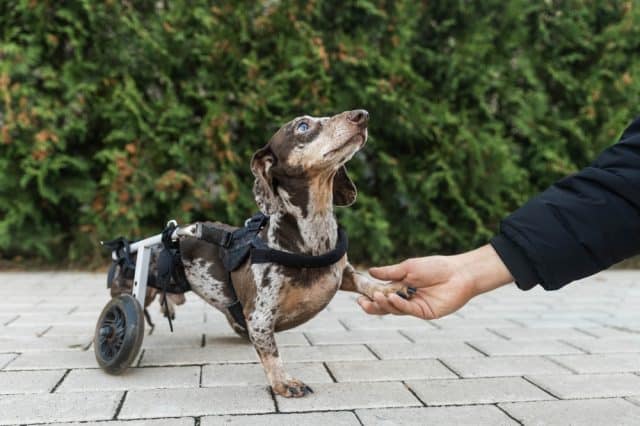
I have seen Dachshunds with ruptured discs, Corgis and Basset Hounds struggling with chronic back pain, and Retrievers limping from hip dysplasia. I have assisted in cruciate ligament repairs that started with what the owner described as a “weird landing.” I have even nursed my own Poodle mix through painful, expensive knee surgeries.
Prevention vs Treatment
Arthritis, hip dysplasia, Intervertebral Disc Disease (IVDD), post-surgical recovery, and general senior weakness all improve when the repetitive impact of jumping is reduced. And even in perfectly healthy dogs, prevention is powerful. Supporting the spine and joints early can delay or reduce degenerative changes later. This principle is widely applied in both veterinary and human orthopedic care.
I always advised clients in small animal practice that prevention costs far less, emotionally and financially, than surgery and rehabilitation. A ramp is not an indulgence; it is smart, proactive care.
Are Dog Ramps Safer Than Dog Steps?
This question comes up often, and it deserves a thoughtful answer.
Impact and Joint Load
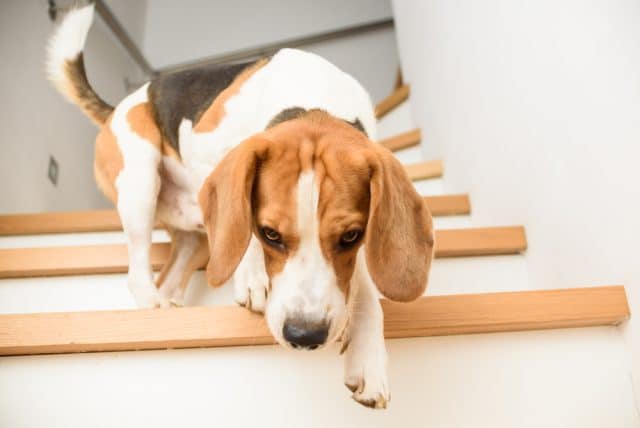
From a simple mechanical standpoint, each stair step involves vertically lifting and lowering the body weight. Each descent involves impact at the bottom. Not to mention, confident dogs frequently skip steps altogether. I have watched plenty of patients bounce down two or three steps at once, completely negating their benefits.
Veterinary orthopedic research consistently shows that cumulative micro-trauma, not just major injuries, contributes to long-term joint degeneration. Using a long, gradual ramp distributes your dog’s weight across an incline as they ascend or descend. Instead of repeated vertical loading, you get a smoother, continuous motion. That difference may seem subtle, but in a dog with arthritis or spinal sensitivity, it can make all the difference.
Breed-Specific Considerations
Breed considerations matter as well. Long-backed breeds such as Dachshunds are predisposed to IVDD, a condition where the cushioning discs between the spinal bones bulge or rupture, putting painful pressure on the spinal cord. When you combine a long spine with repetitive compression forces, you increase stress on the discs.
Senior small dogs like Kio, who often have delicate frames, also benefit from reduced impact. And larger breeds are not immune to impact-related joint problems. Some of the country’s most popular breeds, including German Shepherds, Labradors, and Golden Retrievers, are predisposed to hip dysplasia. Walking up a gradual incline helps support and stabilize them better than narrow doggy steps.
When Dog Steps May Still Be Appropriate
That said, I do believe stairs can be appropriate in certain situations. Young, healthy, athletic dogs using low furniture and wide, sturdy steps may do just fine. But for seniors, orthopedic cases, and breeds prone to joint and spinal issues, I consistently lean toward ramps as the safer long-term option.
What Makes DoggoRamps Different
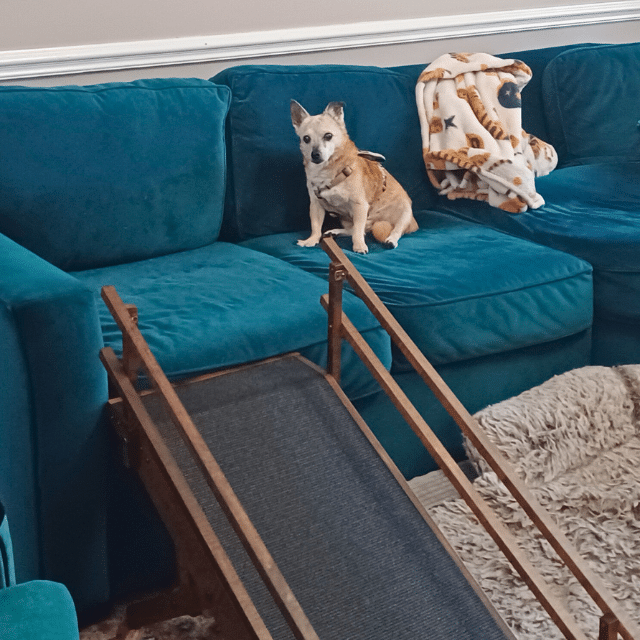
Over the years, I have seen my share of flimsy mobility aids. Plastic steps that wobble. Lightweight pine ramps that flex under minimal weight. When a dog already feels uncertain about their footing, instability only amplifies that fear.
Stability and Construction
DoggoRamps are constructed from furniture-grade, sustainably sourced Maple hardwood. The difference is immediately noticeable. The ramp feels solid and grounded, not hollow or unstable. In my experience, sturdiness directly translates into confidence for the dog using it.
Traction and Surface Grip
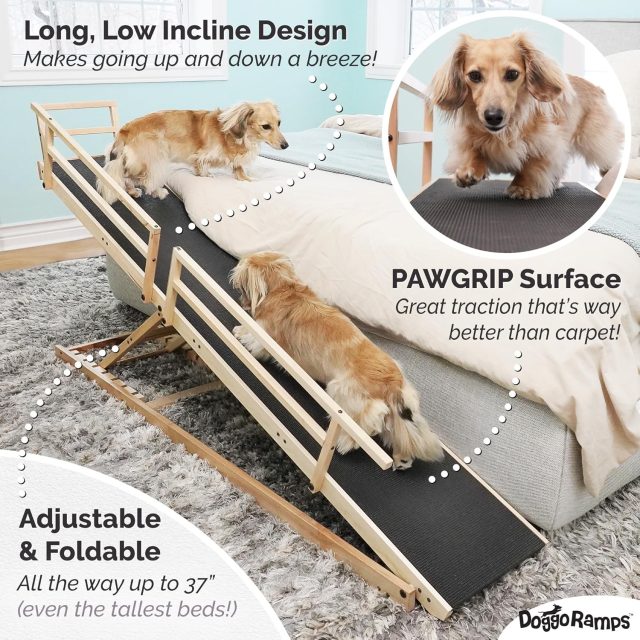
Instead of traditional carpet, which can actually be slippery for many dogs, DoggoRamps uses a unique material called PAWGRIP, which is a soft, rubberized surface that is very grippy on dogs’ paws. For seniors with weak hind legs or dogs recovering from orthopedic procedures, reliable grip is critical. A single slip can undo days of progress or confidence-building.
Side Rail Safety
The double-tiered bolt-on side rails are designed to add additional safety. They have minimal gaps, which helps prevent dogs from attempting shortcut jumps and encourages them to stay safely on the ramp from bottom to top. This structure is especially beneficial for seniors with fading eyesight who need clearer boundaries. In contrast, many ramps use simple dowel-style rails that leave open spaces a small dog could potentially slip through.
Ramp Length and Incline
One of the most important features that truly sets DoggoRamps apart is the long walking surface. Many ramps are shorter because they’re designed as a one-size-fits-all solution for couches, beds, and dogs of all sizes. This results in a steeper incline, putting undue strain on the spine and joints when accessing taller surfaces. The longer walking surface allows for a more gradual incline, even when used with taller beds
In clinical terms, stability plus traction equals trust. And trust is what encourages a dog to use a ramp consistently.
The Story Behind DoggoRamps

DoggoRamps was not created to chase a trend. It was born from experience. Founder Ryan Beauchesne and his Dachshund, Crusoe, faced emergency IVDD surgery in 2016. The surgery itself was around $9,000, followed by months of rehabilitation and additional expenses. Before IVDD, Crusoe had only ever used steps. But after that frightening experience, Ryan understood how critical it was to eliminate jumping entirely and reduce the impact on Crusoe’s spine.
Unable to find a ramp with a long, gradual incline that would sit parallel to the bed, Ryan decided to build one himself. After years of refinement and personal use, the product launched through crowdfunding in 2018. Since then, DoggoRamps has placed ramps in tens of thousands of homes and, alongside Crusoe, helped raise more than one million dollars for IVDD research at Cornell University.
As someone who has stood beside countless families as they navigate spinal surgery and recovery, I appreciate when a company grows from lived necessity and genuine love for a dog.
My Experience With The DoggoRamps Small Dog Bed Ramp
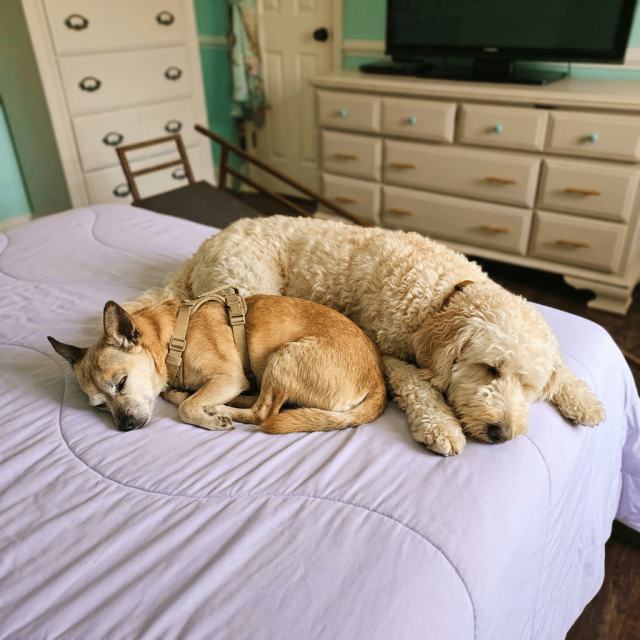
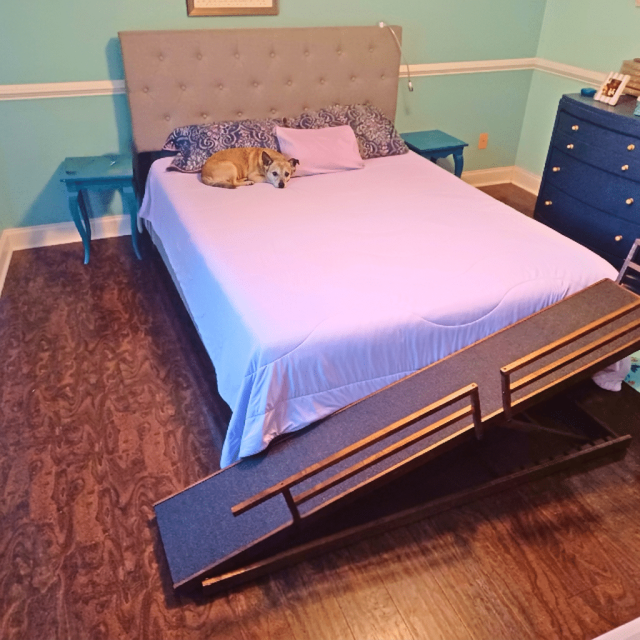
Designed for dogs under 50 pounds, this ramp adjusts across seven height intervals from 12 all the way to 37 inches. That range makes it adaptable to nearly any bed height. For bigger pups, a large version is also available to accommodate dogs up to 200 pounds.
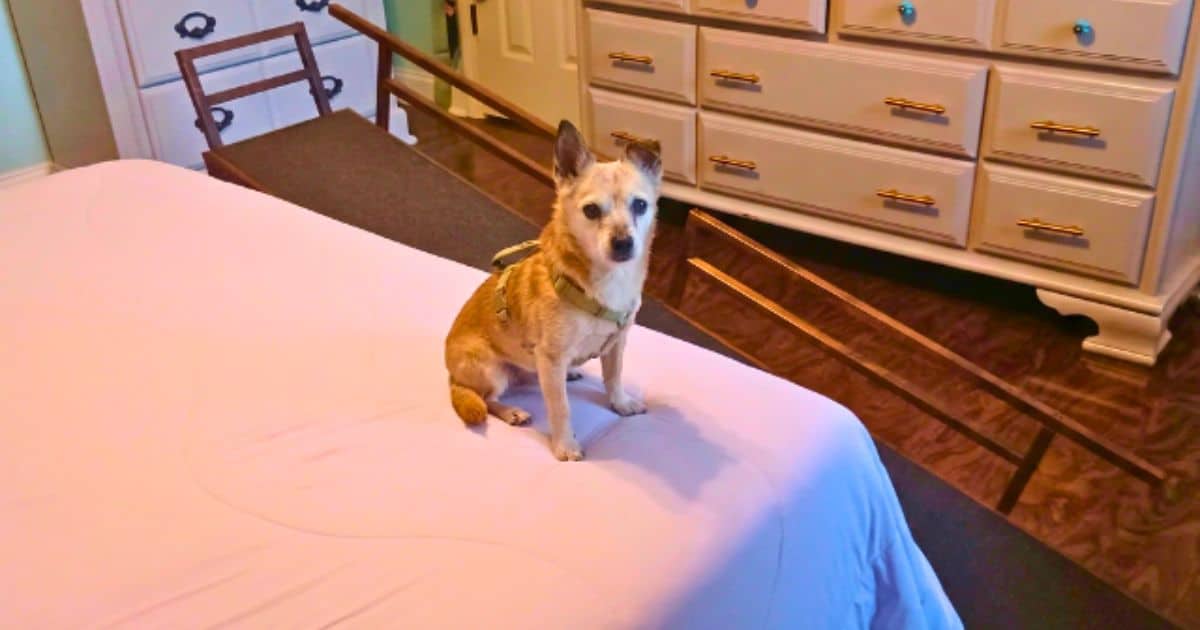
Kio’s Small Dog Bed Ramp arrived fully assembled (which felt like a small miracle for someone with a hate-hate relationship with tools). I only had to attach the rails with the included Allen key. Adjusting the height to match my bed was straightforward, and the anchor rope system securely fastened the ramp to the bed frame for added stability.
I chose the Walnut finish, which blends beautifully with my bedroom floor. The ramp looks intentional, not medical.
Kio was hesitant to go near the ramp on the first day. As a senior rescue dog, he is always a bit suspicious of change. Instead of diving right into training, I gave him the day to examine and acclimate to the new addition. Once he had thoroughly checked it out, I began placing small, high-value treats (string cheese, his favorite) incrementally higher along the ramp, praising him warmly for every step. Within a week, he was confidently walking up and down: no slipping, no scrambling, and no fearful pauses.
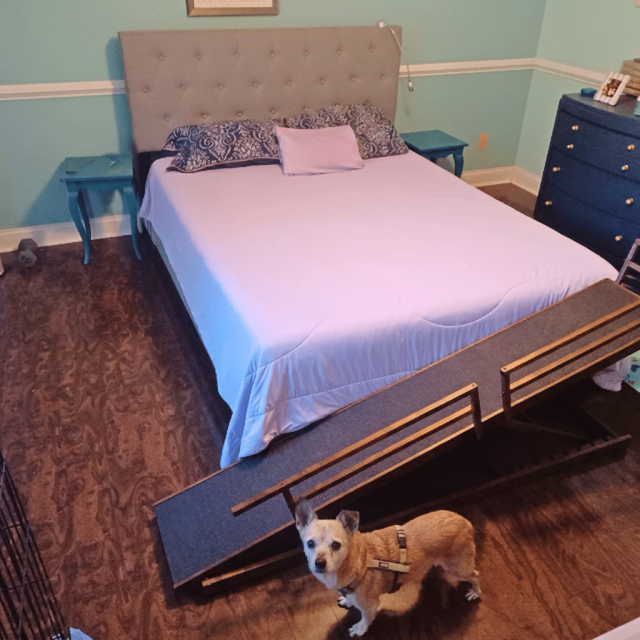
If I had one critique, it would be the absence of a landing platform at the top. Some dogs may benefit from that feature. However, the longer incline significantly reduces steepness, which, in my opinion, offsets that limitation.
Most importantly, I sleep better knowing he can access the bed safely without risking a hazardous jump off the bed into the unknown.
Key Advantages
- Adjustable to all bed heights
- Long, gradual incline
- Solid hardwood construction makes it strong & sturdy
- As nice as a real piece of furniture
- High-traction walking surface
- Secure side rails without any big gaps
- Sits parallel to bed, maximizing space efficiency
Potential Drawbacks
- Heavier than smaller, lightweight alternatives
- Can be a toe-stub risk if you don’t remember it’s there
- Bed version does not include a landing platform
- Higher price point than most alternatives (although for context, a single IVDD surgery can cost $9,000 or more)
- Still requires adequate floor space despite the narrow/parallel design
- The ramp may not work with sleigh beds or beds with large footboards (it would have to be placed along the side of the bed, which can still work but may not be ideal)
My Experience With The DoggoRamps Couch Ramp

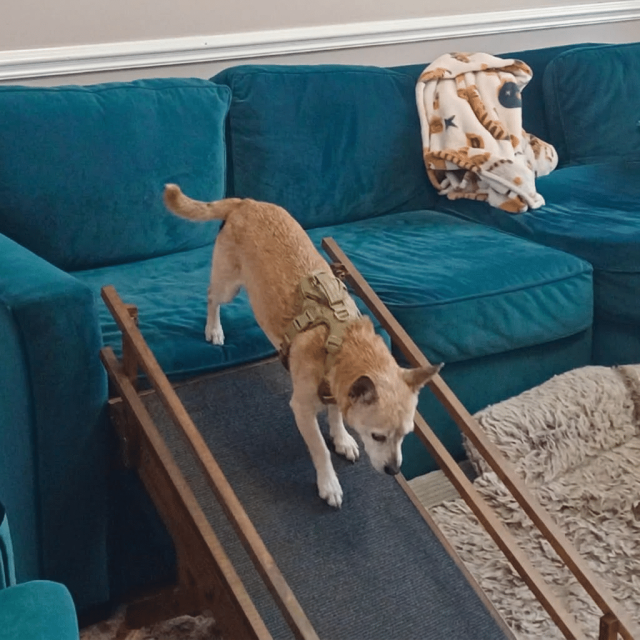
The DoggoRamps Couch Ramp adjusts easily from 14 to 22 inches in height and can support dogs up to 150 pounds, making it well-suited for small breeds like Kio and sturdier medium-sized dogs. It features a thoughtfully designed landing platform at the top to help dogs transition confidently onto the couch, optional safety rails to prevent shortcut jumping, and a foldable frame that allows it to be tucked neatly under the couch or stored upright.
Once again, setup was straightforward and did not require wrestling with complicated instructions or specialized tools. After adjusting it to match the height of my couch, the ramp felt solid and grounded, with no wobble or flex when pressure or weight was applied. Like the bed ramp, the couch ramp is outfitted with a PAWGRIP walking surface, offering reliable traction and the secure footing Kio needs on both ascent and descent.
What surprised me most was how quickly Kio adapted. With the bed ramp, there was a short learning curve. With the couch ramp, he seemed to understand its purpose almost immediately. The landing platform gave him a natural pause point, allowing him to gather himself before stepping onto the sofa cushions. After just a few days, he stopped trying to bypass the ramp and began walking up and down confidently.
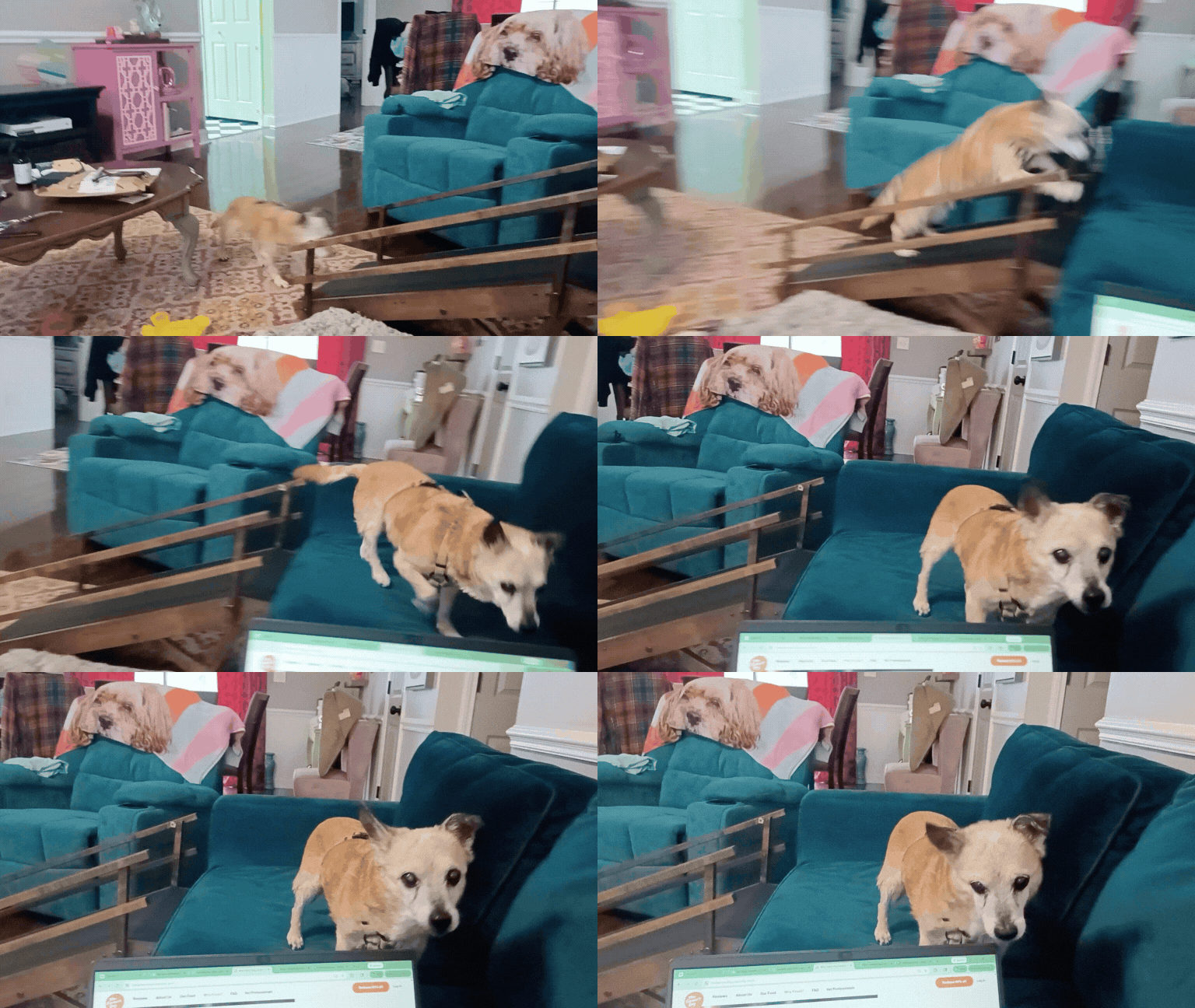
If I were to offer a small critique, it would be that the landing platform could be slightly more spacious for particularly cautious dogs who prefer extra room to reposition themselves. That said, for Kio’s size and confidence level, it has worked very well and has not limited his use in any noticeable way.
The ramp is like a true piece of quality hardwood furniture, and the Walnut finish complements my living room well. In fact, unlike bulky plastic pet steps or utilitarian dog ramps, this is a ramp I would never feel the need to move out of sight when company comes over.
Key Advantages
- Adjustable height and foldable
- Optional side rails that can be configured in various ways (side + top, one-side, double-side, etc.)
- Solid hardwood construction
- High-traction walking surface
Potential Drawbacks
- The landing platform may feel a little small for some dogs
How to Teach Dogs to Use the Ramps
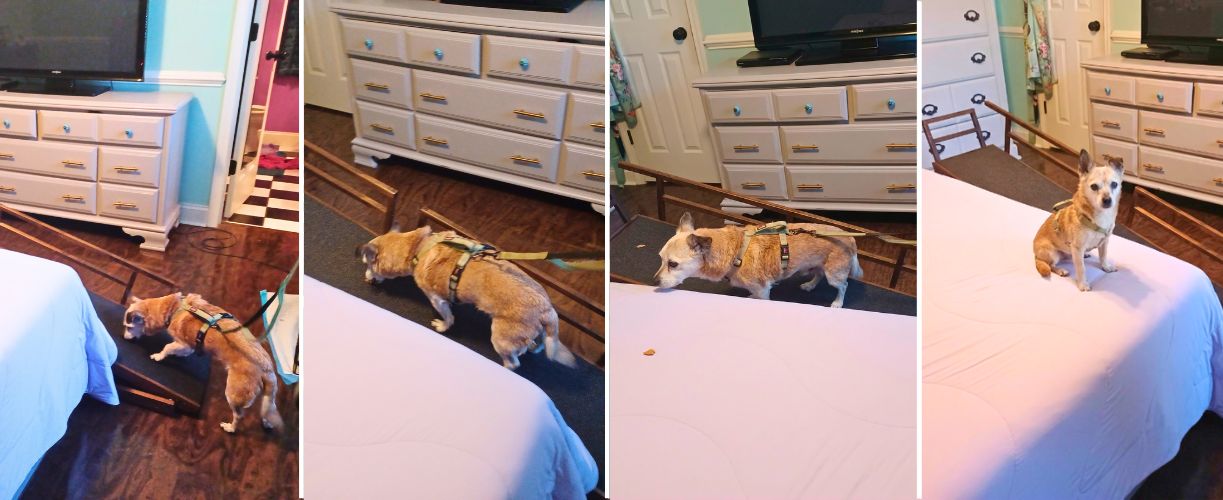
DoggoRamps provides a structured training process, instructional videos, and even personalized coaching if needed. About 95 percent of dogs acclimate to their new ramps within a week, which was definitely the case for Kio.
A Simple Training Approach
From a veterinary behavior standpoint, I would advise buyers to never push, pull, or place a dog onto a ramp. Dogs gain confidence by choosing their own behavior and being rewarded for it. Keep sessions short and positive, and use high-value treats for motivation.
Kio’s progress was steady and encouraging. By allowing him to explore at his own pace and reinforcing each success, the ramp quickly became part of his routine.
Building the Habit of Using the Ramp
One point the DoggoRamps training materials emphasize is the difference between teaching a dog to use the ramp and helping them build a habit of choosing to use it. Many dogs can learn to walk up and down a ramp fairly quickly, but that alone does not guarantee they will use it consistently, especially if they are used to jumping.
The real goal is to help the ramp become their default path as the easiest way down. That means continuing to practice even after your dog understands how the ramp works. Short, positive sessions in which your dog is rewarded for choosing the ramp as the way down from the bed or couch help reinforce the behavior over time.
For dogs with a long history of jumping, this habit-building stage is particularly important. With consistency and patience, most dogs will eventually use the ramp as part of their normal routine.
My Honest Take After Living With DoggoRamps
How My Daily Stress Changed
Throughout my time in clinical practice, I recommended many ramps and mobility aids to clients, but these are the first ones I’ve committed to using long-term in my own home. With my senior dog, Finch, I was his ramp. I lifted his frail body on and off the couch and bed every day. He learned to wait for me, but the responsibility was constant and exhausting. I worried day and night that he would try to jump down while I was asleep or out of the room and seriously injure himself.
Eventually, for peace of mind, I placed a mattress on the floor at the foot of the couch so I could finally relax and get a full night’s sleep. Kio is more independent and doesn’t like being picked up, so ramps are an essential tool to help him stay safe and mobile as he ages.
Why Independence Matters for Senior Dogs
After several weeks of using DoggoRamps, the biggest change is not in Kio; it is in me. I finally feel comfortable leaving him home alone, knowing he can get up and down from the couch safely, and I no longer have anxiety about him jumping off high furniture. Yet, the ramps have done more than restore my peace of mind; they have protected Kio’s independence and preserved his dignity, which means everything when you are caring for a dog in his golden years.
As someone who has seen the consequences of preventable injuries, I believe strongly in mobility support. Senior dogs still crave routine, and they still deserve closeness. Helping them navigate their homes safely protects not only their joints but also their sense of security.
Of course, no mobility aid eliminates all risk, since we are still allowing our dogs to access high furniture. But by offering them an easier way up and down, we can reduce repetitive jumping, meaningfully decreasing the risk of injury and cumulative strain over time.
If your dog is reaching their senior years, hesitates before jumping, has a history of orthopedic issues, belongs to a breed prone to congenital joint/spinal problems, or lives with high furniture, it may be time to consider supportive options.
From the perspective of an experienced vet tech and lifelong rescue advocate, protecting your dog’s mobility is one of the simplest, most meaningful ways to give them more good years by your side.